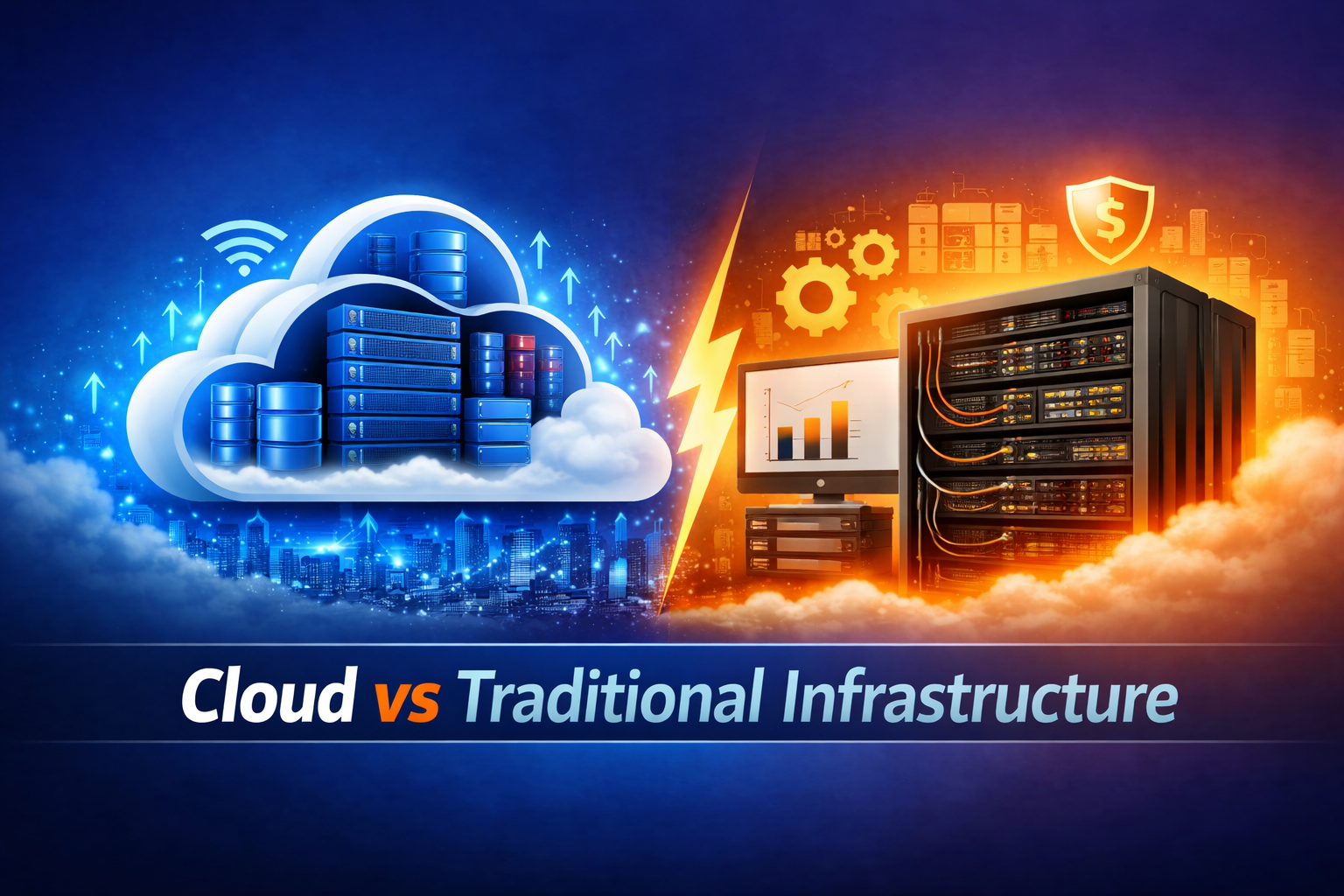
In today's fast-paced business world, brands are constantly looking for smarter means to grow, reduce operational expenses, and enhance efficiency. Technology plays a key role in this journey, and one of the most crucial business decisions that a company has to make is choosing between cloud infrastructure or traditional IT infrastructure.
It is not just a technical decision for growing companies, as it has a direct effect on their scalability, innovation, and success in the long run. As more industries are becoming digital, businesses need scalable and reliable IT systems that can quickly meet the evolving demands.
This guide provides a detailed comparison between cloud infrastructure and traditional IT to help you know the differences between them, the benefits of each of them, and which one is more applicable to a growing business. This article also highlights how expert companies like Dsquare Global offer modern IT consulting and data-driven strategies that are relevant to meet the real-world business requirements.
Understanding Traditional IT Infrastructure
Traditional IT infrastructure refers to the installation where all the hardware, software, servers, and storage systems are physically situated within an organization. The role of purchasing, installing, managing, and maintaining these systems lies within the businesses.
This is a model that has been highly utilized over the decades and has been characterized by complete control of the IT resources. Businesses have an opportunity to tailor systems to their own requirements and gain access to data and security.
Nevertheless, traditional IT is expensive to invest in. Enterprises will have to incur massive costs on hardware, infrastructure installation, IT personnel, and maintenance. The scaling of such systems is costly and more complicated as the company expands.
Moreover, traditional IT settings are usually non-flexible. Any upgrades or expansions take time, planning, and extra costs and may slow down the growth of business.
Understanding Cloud Infrastructure
Cloud infrastructure is a new model of IT that involves the provision of computing functions, including servers, storage, databases, and networking, via the internet. Businesses do not own physical hardware, as they use these resources on demand using cloud platforms.
This method enables business firms to expand in the most rapid way without necessarily investing in physical infrastructure. It is very flexible and efficient, as resources can be added or removed depending on the business requirements.
Cloud infrastructure can also be used to embrace automation, real-time data availability, and the combination with new technologies such as data analytics and artificial intelligence. This is what makes it a potent instrument of companies that wish to expand and innovate.
Organizations like Dsquare Global highlight the significance of cloud-based solutions combined with data engineering and analytics to enable businesses to make quicker and more knowledgeable choices.
Key Differences Between Cloud Infrastructure and Traditional IT
Cost and Investment
Traditional IT is costly to start up. Companies are required to acquire the servers, storage devices, networking equipment, and software licenses. Additionally, there are costs for maintenance, upgrades, and IT staff.
Conversely, cloud infrastructure is based on a subscription or pay-as-you-go model. Businesses pay to utilize only the resources that they use. This helps to save a lot of capital and enables financial planning, particularly for the growing companies.
Scalability and Flexibility
One of the largest challenges of traditional IT systems is scalability. Infrastructure expansion involves acquisition of new hardware, installation, and interconnection of new hardware with existing systems.
Scalability is easy with the help of cloud infrastructure. The businesses are able to scale resources immediately when the demand changes. This is necessary in businesses that have a high rate of growth or a seasonal nature.
Maintenance and Management
Traditional IT systems involve constant monitoring, updates, and troubleshooting. This creates more burden for the IT teams and costs of operations.
Cloud infrastructure simplifies the management process, as it automates a lot of the processes, including updates of the system, system backups, and security patches. This enables the businesses to concentrate on the main side of their operations rather than on the IT maintenance.
Accessibility and Remote Work
In the traditional IT structure, data and applications are normally limited to the office network. This may restrain productivity, particularly in remote or hybrid work environments.
Cloud infrastructure enables staff to have access to information and systems wherever they are, provided they are connected to the internet. This enhances teamwork, adaptability, and general work output.
Security and Compliance
Security is a significant issue to every business. Traditional IT systems offer control over data, but these systems need powerful internal security and 24/7 monitoring.
Encryption, multi-factor authentication, and real-time threat detection are some of the advanced security functions offered by modern cloud platforms. Cloud infrastructure can provide high data protection and compliance with proper implementation and qualified guidance.
Benefits of Cloud Infrastructure for Growing Companies
- Faster Deployment and Innovation
Cloud infrastructure allows the business to implement applications and services within a short time. This saves time-to-market and makes the companies remain competitive. Expanding firms have the ability to develop new ideas, introduce products more quickly, and respond to changes in the market without delays.
- Cost Efficiency and Resource Optimization
Cloud infrastructure reduces costs of maintenance and money spent on purchasing costly hardware.
Businesses have the opportunity of optimizing their resources and investing more in activities geared towards growth.
This is especially useful to startups and small businesses having limited budgets.
- Enhanced Data Management and Analytics
Cloud platforms support advanced data analytics, which allows enterprises to process and analyze a large amount of data in real-time.
Companies like Dsquare Global utilize cloud and data engineering technologies to enable businesses to convert raw data into useful insights to enhance the decision-making process and performance.
- Improved Collaboration and Productivity
With cloud-based tools, teams can collaborate in real time, share files quickly, and work from various locations. This enhances communication and productivity.
- Business Continuity and Disaster Recovery
Cloud infrastructure offers stable backup and recovery measures. Businesses can resume their business quickly in case there is a loss of data or their systems fail. This ensures continuity and avoids the risk of downtime.
Challenges of Cloud Infrastructure
While cloud infrastructure has numerous benefits, one should not forget about its challenges:
- Reliance on internet connectivity can affect access during outages.
- Data migration from traditional systems may be complex.
- Long-term subscription costs can change with time.
These obstacles are manageable using a good planning and professional IT consultation.
Benefits of Traditional IT Infrastructure
Complete Control Over Systems
Traditional IT enables the businesses to exercise complete control of their hardware, software, and data. This would be useful in the case of organizations that have a high compliance standard.
Customization and Specific Configurations
IT systems are personalized to meet operational requirements of companies. This degree of customization is restricted at times in the cloud environment.
No Dependence on Internet Connectivity
Traditional systems do not require internet connectivity, and this makes them applicable to some industries where one cannot be assured of connectivity.
Limitations of Traditional IT for Growing Businesses
Although it does have benefits, traditional IT has various drawbacks to the expanding company:
- High capital investment
- Limited scalability
- Delay in the implementation of new systems.
- High cost of maintenance and operation.
These factors can slow down business development and reduce competitiveness in a digital-first world.
Which One is Better for Growing Companies?
Cloud infrastructure is a better choice for most emerging businesses.
It provides scalability, flexibility, and cost efficiency needed to facilitate rapid growth. Companies can easily adjust to the market, enhance effectiveness, and take advantage of the new technologies.
Traditional IT might still be appropriate to those companies that have certain needs or traditional systems. Nevertheless, it is not always agile enough to suit the modern business world.
The Role of Dsquare Global in Cloud and IT Transformation
As companies switch to cloud infrastructure, professional advice is required. This is where such companies as Dsquare Global come in.
Dsquare Global specializes in assisting companies to modernize their IT systems with cloud consulting, data engineering, analytics, and cybersecurity services. They focus on their approach to enhance scalability, optimize infrastructure, and make data-driven decisions.
They do not provide generic solutions but collaborate with businesses to develop strategies that align with their growth objectives. This will simplify the process of moving to the cloud infrastructure.
How Cloud Infrastructure Drives Digital Transformation
Digital transformation is no longer optional for emerging companies. This is essential to survive a competitive market and succeed.
The cloud infrastructure serves as the platform of this transformation, as it supports innovative technologies, like artificial intelligence and machine learning, and big data analytics.
These technologies are used in automating processes, enhancing customer experiences, and drawing useful insights with data. Consequently, firms are in a position to make sound business decisions, minimize risks, and have sustainable business growth.
Conclusion
The decision on whether to adopt the traditional IT or the cloud infrastructure is a very crucial choice that can determine the future of a developing company.
Traditional IT systems are also easily customizable and controlled but are expensive, lack scalability, and are difficult to operate. Conversely, cloud infrastructure is more flexible, cost-effective, and able to scale at a relatively high speed, which makes it a more viable option to use in business today.
Cloud infrastructure is not a choice but a must for the company that is interested in growing, innovating, and remaining competitive. It allows quicker implementation, enhanced data use, enhanced cooperation, and sustained business achievements.
With the support of professional IT consulting companies such as Dsquare Global, companies are able to fully migrate to cloud-based systems and access new opportunities without taking unnecessary risks.
Ultimately the correct decision is the one that is based on your business objectives, resources, and expansion plan. But in most cases of growing companies, the most intelligent thing to do is to turn to cloud infrastructure as a means of having a more agile and future-oriented company.
FAQs
- What is cloud infrastructure and why is it important?
Cloud infrastructure is a platform under which IT facilities are provided electronically via the web. It is significant as it offers businesses flexibility, scalability, and cost efficiency.
- Is cloud infrastructure suitable for small businesses?
Yes, it is very applicable to small and growing businesses since it lowers start-up costs, and scaling up is easy as the business expands.
- How secure is cloud infrastructure compared to traditional IT?
The cloud infrastructure has high security capabilities like encryption and threat detection. It can also be as secure or even more secure than the traditional IT systems with proper management.
- Can a company switch from traditional IT to cloud infrastructure?
Yes, the migration to cloud infrastructure can be achieved with due planning and professional advice from the company. IT consulting companies can be used to ensure a successful and safe transition.