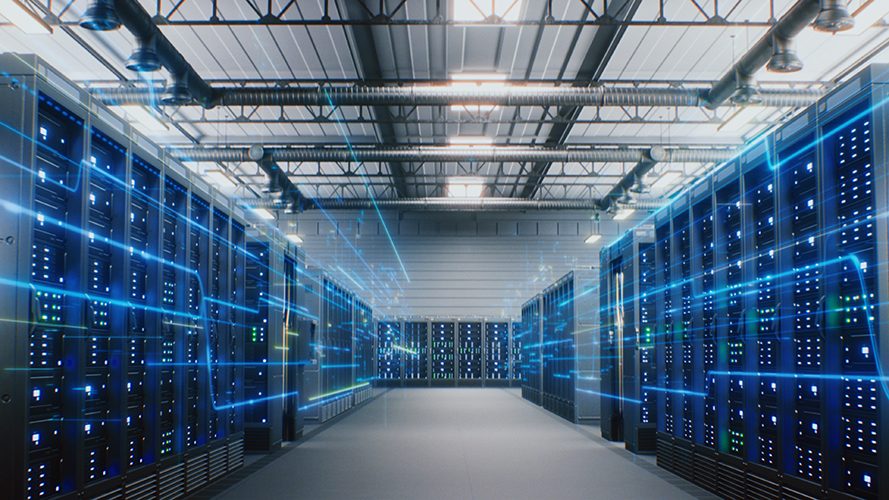
AI data centers in Saudi Arabia are transitioning from intent to execution. Financing has been committed, preliminary capacity targets are established, and conversations are shifting from visionary to merit-based. Today, investors and enterprises want to know what’s viable, and which projects can deliver cash flow returns after breaking ground and confronting operational realities.
Infrastructure built for AI in Saudi Arabia is linked to digital sovereignty, advanced computing needs, and long-term economic diversification. AI compute is increasingly being positioned and planned as a critical piece of national infrastructure akin to energy, transportation, or telecom.
Momentum Behind AI Data Centers in Saudi Arabia:
Reuters reported on January 9th, 2026, that Saudi AI firm, Humain, announced a financing framework for up to USD 1.2 billion from the National Infrastructure Fund, which is linked to projects for up to 250 megawatts of AI data center capacity during early phases.
This announcement represents a meaningful transition from planning to funded development. Linking capital availability to specific levels of capacity provides clarity and signals that AI data centers are in an execution phase across Saudi Arabia, not just policy-level discussion.
Beyond individual projects, broader digital infrastructure demand continues to expand. According to market research estimates from MarkNtel Advisors, the wider Saudi Arabia data center market size is expected to reach roughly USD 3.9 billion by 2030, up from roughly USD 1.9 billion in 2024.
The sector for AI data centers is specifically tailored to that market. It has unique cost structures, revenue drivers, and risk factors.
Why Feasibility Determines Outcomes?
Unlike traditional colocation infrastructure, AI data centers require higher initial capital investments, increased reliance on power/caching efficiency, and concentrated revenue exposure from fewer customers. Instead of earning a stable income from a diversified set of tenants, AI data centers commonly derive revenue from a small number of enterprise or sovereign customers.
Projects reaching the development stage without a thorough feasibility analysis often struggle to secure final approval or suffer from cost overruns during construction and operations. The issue is not the lack of demand, but rather a failure to align technical design with commercial assumptions and financial structure.
Feasibility is not a box-ticking exercise. It is the process that translates ambition into an investable asset within the evolving IT solutions Saudi Arabia landscape.
Core Questions a Feasibility Study Must Answer:
A robust feasibility study will address four key questions to determine if projects move forward.
- Demand and Revenue Visibility:
Demand should be tied to specific workloads or customers. Requirements include:
- Defined enterprise or government workloads
- Anchor tenants or advanced commercial discussions
- Utilisation ramps rather than immediate occupancy
Workloads for AI compute are concentrated. There is not as much risk diversification between tenants as you see in retail colocation. Delays or the loss of even one major contract can significantly impact operating margins and debt service coverage ratios.
- Can the site support AI-grade infrastructure?
AI data centers require specialised infrastructure. Feasibility analysis must include:
- Power availability (capacity and timeframe)
- Cooling systems designed to support dense GPU clusters
- Network connectivity, latency, and redundancy
In Saudi Arabia, power efficiency and cooling mechanics have a direct impact on operating margin. Underestimating thermal loads or overestimating achievable efficiency can lead to long-term operating costs being distorted.
- Does the proposed project meet compliance and regulatory requirements?
Projects must be feasible from a regulatory and risk standpoint. This includes, but is not limited to:
- Data residency requirements
- Licencing and approvals processes
- Environmental and infrastructure frameworks
Regulatory clarity is especially important for AI workloads involving sensitive or sovereign data. Assumptions should reflect current regulatory conditions rather than anticipated changes.
- Does the project remain viable under stress?
Perhaps most importantly, projects need to be able to withstand stressful conditions. Optimistic projections that fail to account for risk are not bankable.
Projects should be stress tested to understand how they behave when:
- Utilisation ramps more slowly than planned
- Power costs increase
- Hardware procurement is delayed
Building a Financial Model for AI Data Centers:
A credible financial model is transparent, conservative, and testable. It allows decision-makers to challenge assumptions without weakening the structure.
- Capital Expenditure (CAPEX):
Typical Capex line items will include:
- Land acquisition and site development
- Power infrastructure and redundancy systems
- Specialised cooling infrastructure for AI workloads
- Computer hardware, including GPUs, servers, networking equipment, etc.
- On-site security and any necessary compliance mechanisms
Compared to traditional enterprise data centers, AI centers will typically allocate larger percentages of CAPEX to power, cooling, and electrical distribution.
- Operating Expenditure (OPEX):
Operating expenditure often drives long-term project viability. OPEX line items will often include:
- Electricity and water costs.
- Operations staff and specialist AI engineers
- Replacement of parts and hardware maintenance
- Compliance costs, monitoring, and insurance
AI hardware refresh rates should be explicitly modelled into the financial forecast. Ignoring hardware retirement or replacement gives you inflated returns and understates capital reinvestment requirements.
- Revenue Structures:
Common revenue models include:
- Long-term colocation contracts, often with minimum commitment periods
- Managed AI Compute Services for enterprise workloads
- Anchor tenant contracts signed with hyperscalers/government entities
Projects without anchor revenue require far more conservative utilisation assumptions and higher contingency reserves.
Financial Metrics Used in Approval Decisions:
Typically, lenders and investors care about:
- Net Present Value (NPV)
- Internal Rate of Return (IRR)
- Payback period
- Break-even utilisation
Each of these should be tested against downside scenarios rather than just base assumptions.
Sensitivity analysis typically includes:
- Power costs increase
- Slow utilisation ramp
- Hardware costs increase
- Delayed schedule/commissioning
If small stress changes materially impact reported returns, the project structure should be revisited.
Market Context for Long-Term Demand:
Long-term demand will be framed by the expansion of digital infrastructure across Saudi Arabia. However, a growing market does not ensure success for individual AI data center projects. Market growth creates opportunity, but individual project feasibility determines success or failure.
Investors should scrutinize standalone economics of AI projects, rather than assume to capture of a share of expanding markets.
Risks That Require Explicit Modelling:
Investors should consider risks unique to AI centers when building their financial models. Among the key risks are:
- Power Costs:
Electricity is the largest operating expense. Small adjustments to power prices impact long-term returns.
- Hardware Supply:
Availability and price of computer hardware can fluctuate wildly. Supply issues impact both CAPEX lines and revenue realisation.
- Utilisation Concentration:
Reliance on fewer contract customers than traditional data centers creates contract risk and revenue concentration concerns.
- Policy Dependence:
If your project needs incentives to work, show what happens if they go away. Don’t leave out assumed incentives during stress scenarios.
Why UAE-based Investors Are Closely Involved?
Saudi Arabia’s geographical proximity to the UAE is not the sole driver of interest from investors. Investors and Enterprises are actively evaluating AI data center projects in Saudi Arabia because:
- Availability of land supporting hyperscale builds
- Government-backed AI initiatives
- Market demand from enterprise and sovereign entities
Investors and sponsors from the UAE will often ask additional questions around structuring, governance, and future exit during the feasibility process.
How Dsquare Global Consulting Supports AI Data Center Projects?
Dsquare Global Consulting offers support with AI data center projects throughout the entire cycle, including:
- Comprehensive feasibility studies grounded in data, not assumptions
- Financial models designed for board and lender review
- Site and infrastructure review for suitability for AI workloads
- Commercial support for anchor tenants and enterprise contracts
Our services are tailored to help clients reach the next stage in their project, whether it's fundraising, contractor negotiation, or permitting.
Pre-Investment Checklist:
Before investing significant sums into AI data center projects, confirm the following:
- At least 1 anchor tenant or advanced contract discussions
- Power & connectivity timelines supported by an MOU or Supply Agreement
- Hardware prices are updated to reflect current market realities
- Financial models tested under downside scenarios
- All necessary regulatory approvals identified
Any gaps in the above checklist will create risk during execution. Investors should use feasibility studies as an opportunity to identify gaps rather than overlook details.
Closing Perspective:
There is significant momentum behind AI data centers in Saudi Arabia. Early indicators of funded-sector deals, sovereignty funding, announced build plans, and government targets are execution markers.
If financed under conditions of feasibility discipline and financial realism, AI projects that are built on transparent assumptions, conservative modelling and stress tested are much more likely to come online and generate predictable ROI.
If you’re considering an AI investment in Saudi Arabia, ask for a feasibility checklist or financial review. Early clarity reduces late-stage risk.