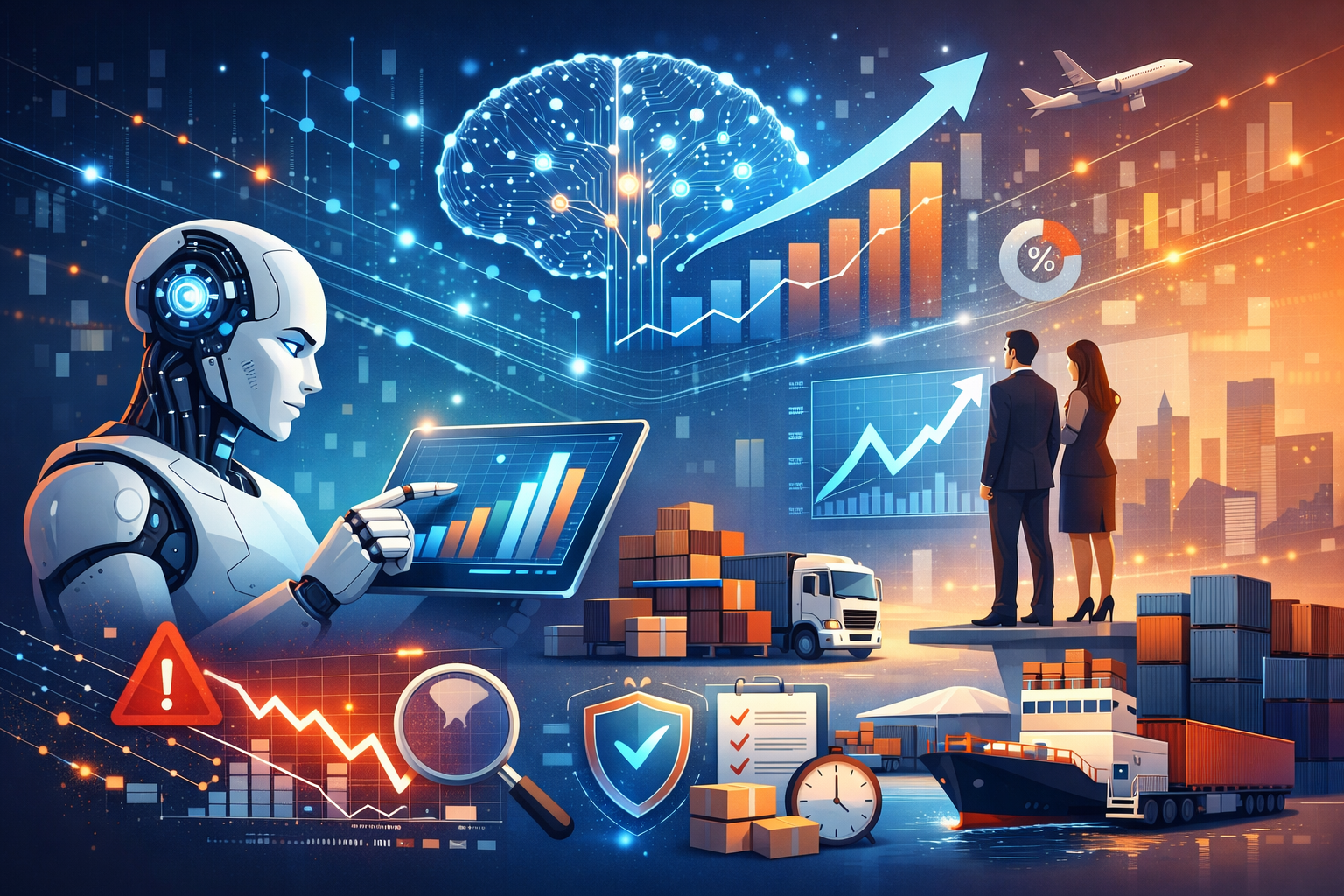
In today's fast-paced digital world, it is quite essential for businesses to make decisions quickly and accurately. This is because nowadays markets evolve rapidly, customer preferences change, and unexpected disruptions may interfere with the operations at any moment. Traditional forecasting methods that depend on historical information and manual analysis are more likely to be slow and inaccurate in prediction.
This is where AI predictive analytics is transforming the manner in which brands operate. Artificial intelligence, machine learning, and complex data processing can help organizations to analyze large volumes of data and predict future outcomes more accurately.
AI predictive analytics will enable businesses to forecast customer demand, detect potential risks before they arise and identify emerging market trends. Businesses can prevent losses by taking proactive measures to enhance performance and minimize losses instead of responding to problems after they occur.
Expert technology firms like D-Square Global are assisting organizations to adopt intelligent data solutions that transform intricate business information into actionable intelligence. By using more sophisticated analytics tools and predictive platforms, enterprises will be able to better the precision of forecasting, minimize the risks of operations and engage in a better driven strategic deliberation and choice.
Understanding AI Predictive Analytics
What is AI Predictive Analytics?
AI predictive analytics can be described as the application of machine learning and artificial intelligence algorithms to analyze both historical and real-time data to predict future events. These systems recognize the patterns within data and use those patterns to forecast outcomes like customer demand, sales performance or market changes.
In contrast to traditional analytics, predictive analytics systems learn from new data continuously. The models also update their predictions and adjust to the changed circumstances as additional information is availed.
AI predictive analytics can assist businesses in predicting demand, forecasting revenue trends, studying customer buying behavior, and participating in better operational planning. This forecasting capability provides firms with a huge competitive edge in the modern markets.
Why Demand Forecasting is Important for Businesses
Demand forecasting is one of the important business planning tools. By properly foreseeing the demand in the future, companies are able to arrange production plans, inventory, and resources to optimize performance.
Nevertheless, false demand forecasts may generate critical operational issues. Companies can end up producing more than what is required and this results in overstocking and high storage expenses. On the contrary, a low estimation of demand may lead to stockouts and missed sales.
This can be overcome using AI predictive analytics, which can predict the business using several data sources at once. These can be historic sales data, customer purchasing behavior, seasonal trends, marketing efforts as well as the economic policies. When all these factors are assessed, the AI systems have the capability of producing highly precise demand projections.
How AI Predictive Analytics Improves Demand Forecasting
Machine Learning Models for Data Analysis
One of the fundamental technologies of AI predictive analytics is machine learning. These algorithms can process large data sets and identify complicated correlations among variables.
For example, machine learning models can inspect how the change in pricing impacts sales, how seasonal events impact demand, or how marketing campaigns impact customer behavior. Gradually, the system is trained on these trends and becomes accurate with regard to predictions.
Organisations that implement AI-based forecasting models usually experience much better demand planning compared to traditional statistical methods.
Real-Time Data Processing
The other significant benefit of AI predictive analytics is the option to work with real-time data. Digital platforms, websites, applications and connected devices have contributed to the massive volumes of information generated by businesses today.
Predictive analytics systems have the capability to process such information in real-time and identify alterations in demand trends. This enables firms to react fast to the market changes.
For example, when an online retailer observes an abrupt rise in product searches or purchases, predictive models can alert the managers to stock more or change the pricing strategies. Real-time insights assists companies to stay agile and competitive.
Discovering Hidden Patterns in Business Data
Today modern businesses create massive volumes of both structured and unstructured data. This information however is not utilized by most since the traditional tools are not able to analyze it effectively.
AI predictive analytics solves this problem by applying advanced algorithms to detect hidden relationships with complex datasets. These insights tend to expose opportunities or threats that are not visible to human analysts.
Firms such as D-Square Global come up with smart analytics solutions that enable organizations to transform raw data into useful strategic information. Organizations are able to predict the demand pattern and make superior operational choices through the techniques of predictive modeling and advanced analytics tools.
How AI Predictive Analytics Reduces Business Risks
Supply Chain Risk Management
Supply chains are susceptible to disruptions caused by delays in the transportation system, supplier issues or abrupt variation in demand. When such disruptions take place, they may affect the production and customer satisfaction in a negative manner.
AI predictive analytics can assist companies in tracking data within the supply chain and predicting the possible issues ahead of time. Predictive models have the ability to process shipping schedules, supplier performance, and shipping logistics data to anticipate risks earlier before they develop.
Anticipation helps companies to modify production schedules, find alternative suppliers, and stabilize the operations in case of disruption in the supply chain.
Inventory Optimization
Inventory management is a very significant area of business activities. Ineffective inventory planning may lead to oversupply or lack of a product.The companies can predict the most appropriate levels of inventory to be held in order to satisfy the anticipated demand with the help of AI predictive analytics. The predictive models are used to analyze the historical sales history, seasonal and market indicators to project future product demands. This helps companies to save on storage expenses, avoids stock outages and helps businesses to provide customer products when they are in need.
Financial Risk Prediction
Financial risk management is another area where predictive analytics is widely used. Through the examination of financial reports, transactions, and data available on the market, AI systems can predict revenue patterns and identify possible risks to finances.
Predictive analytics helps financial institutions to detect fraud, analyze credit risks, and advance investment policies. These capabilities can also be used by businesses in other industries to enhance financial planning by making use of predictive insights.
Market Trend Forecasting
Markets change constantly due to shifting consumer tastes, changing economic situations, and technological advances. Companies that do not adapt to these market changes quickly can lose the competitive edge.
AI predictive analytics enable organizations to review consumer behaviour, market trends, and competitive actions. The consideration of these factors can help businesses to know the future trend in the market and modify their strategies to suit the market. This proactive method allows companies to outperform the changes in the industry and ensure long-term growth.
Key Business Benefits of AI Predictive Analytics
- Better decision-making: Among the most important benefits of AI predictive analytics, there is a rise of better decision-making. Data-driven insights can be trusted by the business leaders instead of assumptions and intuition.
- Forecasting accuracy: Predictive analytics also enhances accuracy of forecasting. When organizations have a better view of the future demand, organizations can be able to plan production schedules, manage supply chains, and also allocate resources more efficiently.
- Cost optimization: Cost optimization is also another significant advantage. Making predictions of the demand and optimizing operations helps companies to reduce waste, minimize the costs of operations, and enhance profitability.
- Enhance customer experience: Customer experience also improves using predictive analytics. The analysis of the customer behavior and buying habits can help businesses customize the marketing campaigns and offer improved product suggestions.
Applications of AI Predictive Analytics Across Industries
AI predictive analytics has been used in many industries to enhance efficiency and minimise risks.
Retail and E-commerce
Predictive analytics are used in retail and e-commerce to aid the businesses in predicting the demand of their products, price optimization, and inventory management. Retailers are able to predict the seasonal demand and make sure that they are stocked with the popular items.
Manufacturing
Predictive analytics is used by manufacturing firms to organize manufacturing schedules and the needs of materials. Manufacturers can minimize downtimes and maximize operational performance due to predicting equipment failures and changes in demand.
Healthcare
Predictive analytics are applied in healthcare organizations to predict the number of patients and to control the medical resources. Once the hospitals know the trends of patient flows in the future, they will be able to allocate their staff and equipment.
Financial
Predictive analytics is applied in detecting fraud, credit risk, and investment analysis by financial institutions. Banks are able to identify fraudulent activities at an early stage by establishing patterns that are unusual in the transactions.
How D-Square Global Supports AI Predictive Analytics Implementation
Companies that intend to implement AI predictive analytics need high-tech technology infrastructure and data science skills. The implementation of predictive analytics solutions implies the combination of several different data sources, development of machine learning models, and the creation of analytics platforms that provide real-time information.
D-Square Global offers smart solutions of data analytics and predictive modeling that assists organizations to extract the maximum out of their data. Their technology platforms enable businesses to gather, process and analyse great volumes of data effectively.
With the help of sophisticated analytics tools, businesses can have a better understanding of the demand trends, customer behavior, and market trends. These understandings can aid organizations in mitigating risks, enhancing operations as well as in the performance of the business over time.
By collaborating with D-Square Global, companies are able to adopt scalable AI-based analytics solutions that can be used to make smarter decisions and transform digitally.
The Future of AI Predictive Analytics
The future of AI predictive analytics is directly related to the development of artificial intelligence, big data, and cloud computing. Predictive analytics will be further enhanced once more as companies continue to produce large volumes of digital information.
Predictive capabilities will be further expanded with the help of emerging technologies like the Internet of Things, real-time data streaming, and advanced machine learning algorithms. The companies will be able to predict the demand more precisely, anticipate risks at an earlier stage and optimize the operations in real-time.
Organizations that invest in predictive analytics today, will be more prepared to adjust to the conditions of the changing market and keep their competitive edge.
Conclusion
In today's data driven world, business success depends largely on accurate forecasting and risk management. AI predictive analytics allows organizations to analyze huge and complex datasets, detect trends, and predict future trends with a high degree of precision.
Predictive analytics enables businesses to run more efficiently and make smarter decisions by enhancing demand forecasting, optimizing supply chains and reducing operational risks.
Companies like D-Square Global have significantly contributed to the adoption of AI-powered analytics solutions in organizations. Businesses can use their data to generate strategic insights that leverage development and growth in a sustainable manner using highly developed data intelligence platforms and predictive models.
FAQs
1. What is AI predictive analytics?
AI predictive analytics is an artificial intelligence-based technology that employs machine-based learning algorithms to analyze historical and real-time data to predict future trends and business results.
2. How does AI predictive analytics improve demand forecasting?
Predictive Analytics makes use of the customer behavior, past sales data and market trends to predict the future demand more precisely, which assists businesses in planning inventory and production.
3. Can AI predictive analytics reduce business risks?
Yes. Predictive analytics using AI can identify supply chain disruptions, financial risks, market changes, and operation inefficiencies before they happen so that businesses can prevent them.
4. Why should businesses use AI predictive analytics solutions?
Predictive analytics based on AI helps businesses to make better decisions, enhance future forecasting accuracy, minimize their operational expenses, and obtain competitive advantage in the industry.